 “I need to lock in.”
If you’ve found yourself saying that, you’re in the right place. This guide will show you how to improve your focus so you can get stuff done.
The strategy here will make you more productive whether you’re a student who needs a C for a degree, an office drone living the dream each day, or a random blogger giving freely to the internet like myself.
I refined this method during my experience writing over 100 articles. It’s also approved by my engineer alter ego who’s been in the workforce for a decade, so I’m sure it’ll work for you.
But before we get to the actual strategy, let’s take care of some pre-work.
Mental Pre-Work: Slay the Avoidance Dragon
You will face a form of internal and external resistance before you even try to focus. We need to address this first.
Otherwise, you’ll sabotage yourself because…
- You’re not ready
- You’re too tired
- You’ll miss the game
- You need to check social media
- You want to relax
- Your family needs you
- You’re not inspired
- You’ll miss a show
- You’ll waste your time
- You need to workout
- Your friends want to hang
- Your place needs cleaning
- You’re not smart enough
Those desires, responsibilities, and doubts will assault you before you even start.
All this initial resistance is like a dragon to slay. It’s a dragon guarding the treasure of focus within your mind.
Yes, this opposition can feel overwhelming, but here’s the good news:
The actual work isn’t as scary as the dragon makes it seem.
If you simply say “no” to your avoidance urge, you do the immense task of slaying the dragon. And once that thing’s out of the way, focusing isn’t hard at all.
So how do we say “no” consistently and just start?
Here are a few tips.
How to Slay Your Dragon
 Tip #1: Get FOMO for Focus
Everyone talks about FOMO, the fear of missing out, when discussing how hard it is to avoid distractions. But what about the FOMO involved with not focusing on your work?
If you always give in to the dragon…
- You won’t get the grades you want
- That book in your mind will never get written
- And the promotion you could’ve earned will go to someone else
Now compare this to what happens when you ignore your phone. You might be an hour late to sports news or miss what your ex posted about her vacation, but is missing out on that really worse than foregoing life-changing achievements?
Tip #2: Remember “No” is Temporary
It’s easier to deny something you want when you know the choice isn’t permanent.
I’m not trying to make you swear off entertainment, social media, or responsibility. I’m a huge Boston Celtics fan after all. I watch almost all of their 82-plus games a season, yet I’m still able to write because I focus consistently at other times.
You don’t need to be a hermit obsessed with work to focus. You just need to decide what’s important, and temporarily say no to everything else.
Tip #3: Realize Focus Brings Satisfaction
Most of us don’t slay our dragon because we don’t think work is enjoyable. We’ve been conditioned to believe frustration, exhaustion, and apathy are all work has to offer.
We would much rather feel something positive. That’s why we spend hours relaxing and doom-scrolling instead.
Well, if good feelings are what you’re after, understand that focused effort is different than the work you know. Concentrating on a single task and making progress is satisfying. And the competency you gain doing this breeds passion even when you don’t care about the material.
These feelings prove our minds weren’t made to be coddled by screens. They were made to fix problems, overcome challenges, and get stuff done.
Sure, that may sound like cheesy motivation, but the sense of achievement I feel after each session confirms I’m doing something right.
How to Focus: 5 Steps to a Successful Focus Session
Now that you’ve hopefully slain your dragon, we can get to the actual strategy.
Below are five detailed steps guaranteed to help you lock in right now.
Step 1: Choose One Focus-Worthy Task
First, you need to decide what you’ll actually do.
You could have all the motivation in the world, but if you don’t limit the endless options you have to work on, you’ll just stare at a blank screen. This is the time to nail down a specific task so you know where to direct your focus.

As a writer for example, I don’t just write. I make outlines, pen drafts, edit those drafts, and do whatever else necessary to make articles appealing. My focus session could include any of those activities, so I need to define exactly which one to do.
Now let’s say you’re studying—that could involve plenty of tasks. Will you rewatch lectures, review notes, read the textbook, check a study guide, or practice examples? That’s for you to decide.
Choosing exactly what you’ll do up front will make it so much easier to concentrate. Just make sure whatever you choose actually requires that focus. You don’t want to pick a low-level task like filling paperwork that you could easily do while distracted.
Key Tip: Choose a task, not a goal
It’s important, however, to choose a task here, and not a goal. You want a specific idea of what you’ll work on, but don’t commit to finishing it.
I know that’s blasphemy in our productivity-obsessed world, but if you think about it, you already have a goal.
Your goal is to commit to the session itself.
Let the work take as long as it takes. Your job is to follow the system that gets work done.
Step 2: Create a Productive Environment
Next, we need a suitable environment to do the tasks we planned. Here’s what you do to make one.
Define and Gather Tools
There’s nothing more frustrating than driving 20 minutes, setting your desk, mustering up willpower, and then realizing you left something at home.
What tools do you need to work on your planned tasks? Maybe you need your laptop, a mouse, your notebook, your bookbag, or even a water bottle.
Whatever it is, make a checklist on your phone to make sure you’ve got it all.
Choose a Focus-Friendly Place
I am not a superstitious person. I don’t have to sit in the same chair in the same room to focus, but there are similarities between the best places you and I should choose.
In general, you want an organized space that’s free of distractions where you’d feel comfortable working. Try to avoid TV’s, loud environments, and large numbers of moving objects or people.
I’m a library guy myself as I find it easiest to work in a public space where others are focusing. I’ve also dedicated a table at my place for sessions when I don’t feel like going out. Some people are fine with cafés and coffee shops, but those tend to be a bit much for me. I always run into the most loud-mouthed people on earth when I work anywhere else in public, so I just avoid the risk.
Wherever you choose though, be honest with yourself and decide if that environment really helps you stay on task.
Enhance Your Workspace
 Sometimes, even good locations can be improved.
I said I enjoyed working at the library for example, but it’s not rare for people with zero self-awareness to barge in, so instead of staying at a common area desk struggling to concentrate, I’ll either go upstairs to a quieter section, or sign for a study room that’s even more secluded if one’s available.
The trickiest situation though, is when you can’t change where you work. Most people can’t leave their desk on the job no matter how much more productive they’d be, and I’m unfortunately part of that group.
I have an open office setup at my day job with multiple coworkers in a small room. The office also has a couple 3D printers—one of which beeps constantly behind my desk—and radios everywhere that could call for me or one of my peers at any moment.
One of the best investments I made to combat all this is a pair of noise cancelling ear buds. I connect them to my work PC, take calls, and toggle the noise cancelling when I need to start a focus session.
I highly recommend buying a pair of headphones or earbuds with good active noise cancellation (ANC) if you can afford it. Not only have they improved my ability to focus at work, they’ve allowed me to transform just about any space with silence.
My Sony XM4’s are one of my most cherished possessions, but that’s an older model and new ones are hard to find now. I recently purchased the Apple AirPods Pro 3, however, and the ANC on those is outstanding. (That’s an Amazon affiliate link by the way.*)
Yes, both models were expensive, but the noise cancellation alone is worth it to me. Be prepared to spend at least $100 for a cheaper option though if you want reliable ANC.
If you don’t want to spend at all, you could always take any pair of earbuds or headphones and play white noise in the background. Doing this will drown out low-level noise too without distracting you with lyrics and chaotic instrumentals.
Step 3: Reduce Your Accessibility
One of the easiest ways to improve your focus is to become a ghost.
You want to limit both your access to the outside world, as well as the world’s access to you.
Limit access to the world
When you’re ready to start a session, put your phone on Do Not Disturb and leave it in your pocket, a bag, or even another room.
Yes, you might need your phone during some sessions, but I recommend using a laptop or other device instead if possible. It’s much easier to keep work on a laptop screen than it is on your phone. And that’s not even mentioning the barrage of texts, emails, and notifications your phone tempts you with at random times.
If you end up using a laptop or PC though, close the web browser and only use it if it’s actually needed. You may want to turn off Wi-Fi too until you need to browse.
Once you do go surfing, download and use a separate browser than your normal one for personal use. If you use Safari for everyday entertainment for example, download Chrome as your official browser for focus sessions. Doing so will make a clear distinction between work and play.
Limit the world’s access to you
 If your phone’s on DND already, you have a head start. Just make sure to close any IM or email apps on other devices. You can also put a block on public calendars so your status shows as busy online.
Remember, focus is a limited resource, and you want to spend it on your most demanding challenges. Answering emails, texts, and phone calls is not demanding, so don’t waste focus on that when you can do it at almost any time in any environment.
Think about how much communication you see throughout the day too, and ask yourself how much of that was really urgent. How many emails couldn’t wait another hour for a response? How many texts absolutely needed an answer as soon as they were received? Chances are, it’s not many.
Most daily communication is not urgent, so don’t be afraid to cut the world off.
You may feel like a jerk at first, but once you push the limits of what you can avoid, you’ll see that you have more freedom than you think. And even if you do get push back here, you’ll at least have a better idea of what’s important and can adjust as necessary.
Key Tip: Tell loved ones what you’re doing
With all the above said, I do recommend telling the people closest to you about your disconnection. The last thing you want are hurt feelings in your close circle because people think you’re ignoring them.
Legitimate emergencies are also a thing. Give your loved ones a workaround to reach you in case something happens. Most of them should be supportive enough to let you focus anyway, so do right by them, and let ‘em know how you can always be reached.
Step 4: Break Sessions Into Blocks
Working in blocks of time has been a gamechanger for me. Before, I used to work in uncapped sessions like most people do, and that method undermined my progress.
Yes, I’d have days where I could easily focus for 2 hours of work, but on days when I couldn’t meet that mark, I’d get frustrated and goof around. My best days set an unrealistic standard for what I’d be capable of at my worst. And on those days where I was especially tired, I’d settle for a rest day because of it.
Instead of letting feelings guide you like that, break your sessions into small chunks of time.
I mostly work in 60-minute blocks now, but I’ll go up to 90 minutes at most if the brain juices are flowing. For beginners though, it’s best to start with a 30-minute block and see how you do. After that, take a 10-to-15-minute break to catch up on messages, use the restroom, and just chill. Then once the break is over, turn everything back to Do Not Disturb and put the focus back on your work.
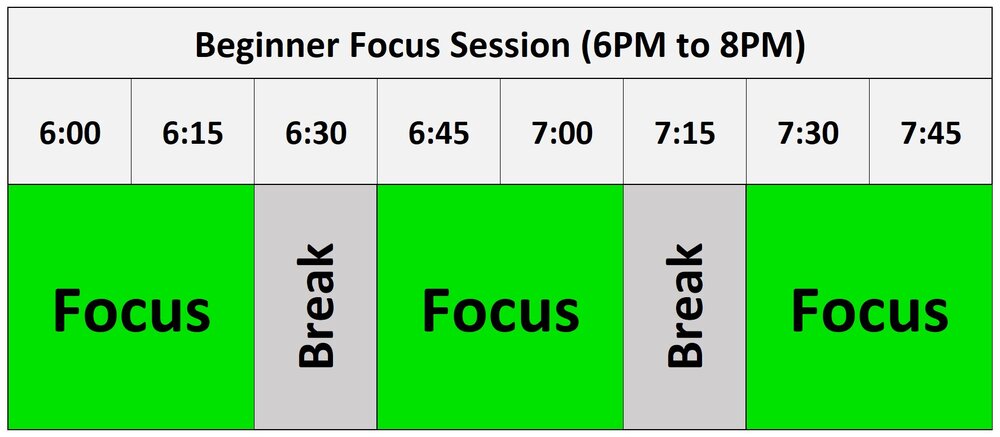
This change may seem very simple, but working in block patterns brings a ton of benefits.
The Benefits of Working in Blocks:
- Starting is easier because you have an approachable time commitment
- Long sessions are less of a slog because you have frequent breaks in between
- You have enough time to reach a flow state but not so much that you burnout
- Your ability to focus on demand improves due to practice switching between focus and rest
- Blocks are limited to a socially acceptable time to miss more urgent communication
I like to think of this block method as swimming. You have moments of deep concentration under water then resurface to breathe in a rhythmic motion.
Some days, especially during the work week, my session will only consist of one hour-long deep dive. But when I have more time on the weekend, I can usually string 3 to 4 blocks in a session.
I love working this way because the structure ironically allows me to be spontaneous. If I’m just sitting around at my place for example, I’ll squeeze in a block real quick.
The ability to flip the switch like this has done wonders for my day-to-day consistency. So try it out if you want sustainable progress too.
Step 5: Stay Active or Passive Each Block
Once you have your session planned and you know to work in blocks, it’s time to optimize for your best performance.
The way to do this, on top of all the other efforts we made to increase concentration, is to focus your thinking itself.
During each individual block, you need to stay in either active or passive mode.
What do I mean by “active or passive”? I mean each task you choose requires one of those modes of thought. You will either use active thinking, which primarily creates, or passive thinking, which primarily reacts.
Here are a few examples of each:
Active Thinking Tasks
- Writing a rough draft
- Programming
- Making a presentation
- Outlining a script
- Recording audio
- Designing an object
Passive Thinking Tasks
- Researching material
- Taking notes
- Editing a draft
- Manipulating a spreadsheet
- Auditing data
- Reviewing a lecture
You can argue there’s overlap between the two types, but this is a good way to distinguish the form of thinking required.
There’s a huge difference in how I think writing a draft versus when I edit for example. And if I try to edit my work during creation, it tanks my productivity.
This is why I recommend staying in the same mode of thought. If you have multiple blocks in a session, it’s okay to switch your thinking after each break, but don’t use active and passive mode at the same time.
As a more experienced writer now, I’ve learned to limit my desire to edit when drafting and instead just focus on filling the page. I trust future me to handle all the edits later.
Take a look at your tasks too and make sure you don’t switch thinking modes too often. Define your actions as either active or passive first, then follow some of the tips below for more productive sessions.
During Active Blocks…
- Limit judgment of created work (your first attempt will usually be bad, so just get it out the way)
- Focus on putting words, numbers, or code on the page (edits will come later)
- Remember that making too much material is better than not having enough
During Passive Blocks…
- Judge your work as a consumer during edits and not as its creator
- Research or study until you’re bored of the material (boredom is a symptom of mastery)
- Take handwritten notes whenever possible (writing by hand makes memorization easier)
How to Focus: A Summary
 Okay, I know that was a lot, so let’s summarize everything here.
First, slay your avoidance dragon so you can actually start, then…
- Choose one focus-worthy task
- Create a productive environment
- Reduce your accessibility
- Work in blocks of short time periods
- Stick with active or passive thinking each block
No gimmicks, no hacks, no scams. These are just practical steps you can take to improve your focus right now.
Don’t relegate this strategy to emergency use hours before a deadline or exam though. This is a routine to complete each day as long as there’s work available.
So keep chaining those days of successful focus, and remember that your best work always starts by simply saying “no”.
-Drew
Note: Some ideas in this article were inspired by Cal Newport’s Deep Work: Rules for Focused Success in a Distracted World (affiliate link*). It’s a good read if you want more information about focused work and some alternative focus methods.
*As an Amazon affiliate, I receive a small commission on any items purchased through affiliate links. I only link items I’ve used and recommend though.
Leave a Reply