 “Where are you from?”
To many, that question is an innocent inquiry of your past. People want to learn more about where you lived so they can get to know you. And as soon as you respond with a city, state, or country, they’ll learn a lot more than the answer you give.
A simple location gives presumptions of your social status, ideology, and expected behavior. That place may only be a dot on the map, but it says much more than you ever could in five words or less.
Where you lived isn’t just a footnote in your history. It’s a glimpse into your identity…or at least, it usually is.
As someone who grew up in a military family, I don’t have the luxury of saying, “…born and raised”. My dad retired and moved us to what’s now my hometown when I was young, but it was too late then to not see everything there as different.
- The humidity was suffocating compared to our last stop in the desert.
- The names of stores and restaurants were so odd I couldn’t pronounce them until I heard them mentioned in ads.
- And the southern drawl I found hilarious was somehow accepted without batting an eye.
Over time, I got used to those differences, but even now as an adult living nearby, I can’t honestly say I belonged. No matter where I lived since, there was always a reason why I couldn’t wholeheartedly claim that place as my own. Heck, I can’t even drive to work today—in the 21st century—without a Confederate flag reminding me that I don’t fit in.
Issues like this are why identity can’t always be gleaned from a location.
Everyone wishes they could answer “where are you from?” and be understood. But many of us hear “where are you from?” and know the following implication: “…because you can’t possibly be from here.”
Recently, however, I got a chance to see another way of life. I made a trip to see my beloved Boston Celtics play at home for the first time. And even though the team put up one of the worst stinkers of the season (figures, right?), the city endeared itself to me in a way I never expected.

The convenience of public transportation, the rich history of monuments and museums, the proximity of higher education, the relative sense of safety, and the nerdy attractions that enthralled my engineering brain all resonated with me.
There was also an intentional effort city-wide to promote messages of belonging. And for a place that hasn’t historically had the best race relations, I saw more diversity there than I’ll ever see in my hometown.
The whole trip was an awesome experience—so much so that I actually felt regret on the way home. No, not the “take me back” kind of regret a 20-something girl gets when she leaves vacation, but regret in the sense that I wished my life was different.
I’ve been outside the U.S. a few times and visited numerous cities domestically too, yet no matter where I went, I was always happy to come home to what’s familiar—my own place, my own bed, you get the point.
But I wasn’t this time.
How could I be when I finally found where I felt I belonged?
What if growing up in my hometown was a mistake? What if the college I chose to attend was the wrong choice? What if I missed out on a life that matched my identity?
That’s the kind of doubt that can strangle us all. The desire to belong is so powerful that it leads to life-changing decisions. I know my imagination went crazy going through scenarios in my head.
But then I finally came to my senses. I remembered that my identity died long ago. “It is no longer I who live, but Christ who lives in me”.
I know the whole “God has a purpose for everything” idea gets thrown around too much, but I’ve already seen how He’s worked through me where I am right now. And who knows if I would’ve influenced certain people if I didn’t grow and live where I did.
The truth is that no place on earth is perfect, and it won’t be no matter how much we try to improve it.
Even the city I felt such a strong connection to had a glaring problem: it was full of “whitewashed tombs”. There were beautiful churches everywhere that aren’t really churches at all. Their signs relayed universalism, liberal theology, and other false teachings that leave people worse off than before.
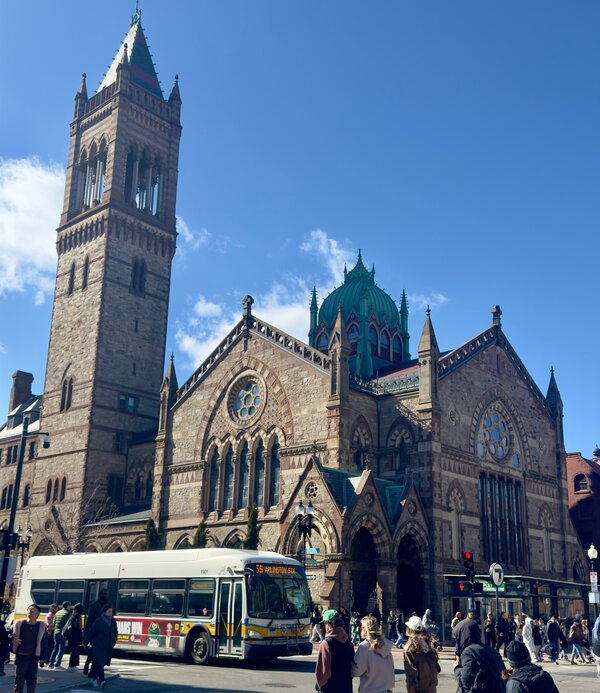
What if I did grow up there? Would I look happy while longing internally for truth I’d never find? Would I be so distracted by other interests that I’d never gain my most prized possession?
I don’t know.
But I remember now that the place I belong to isn’t in this world. I’m a citizen of a place I can proudly call my own.
So no, you can’t know me by asking where I’ve been or where I am.
My identity is forever tied to where I’ll be.
-Drew
Leave a Reply